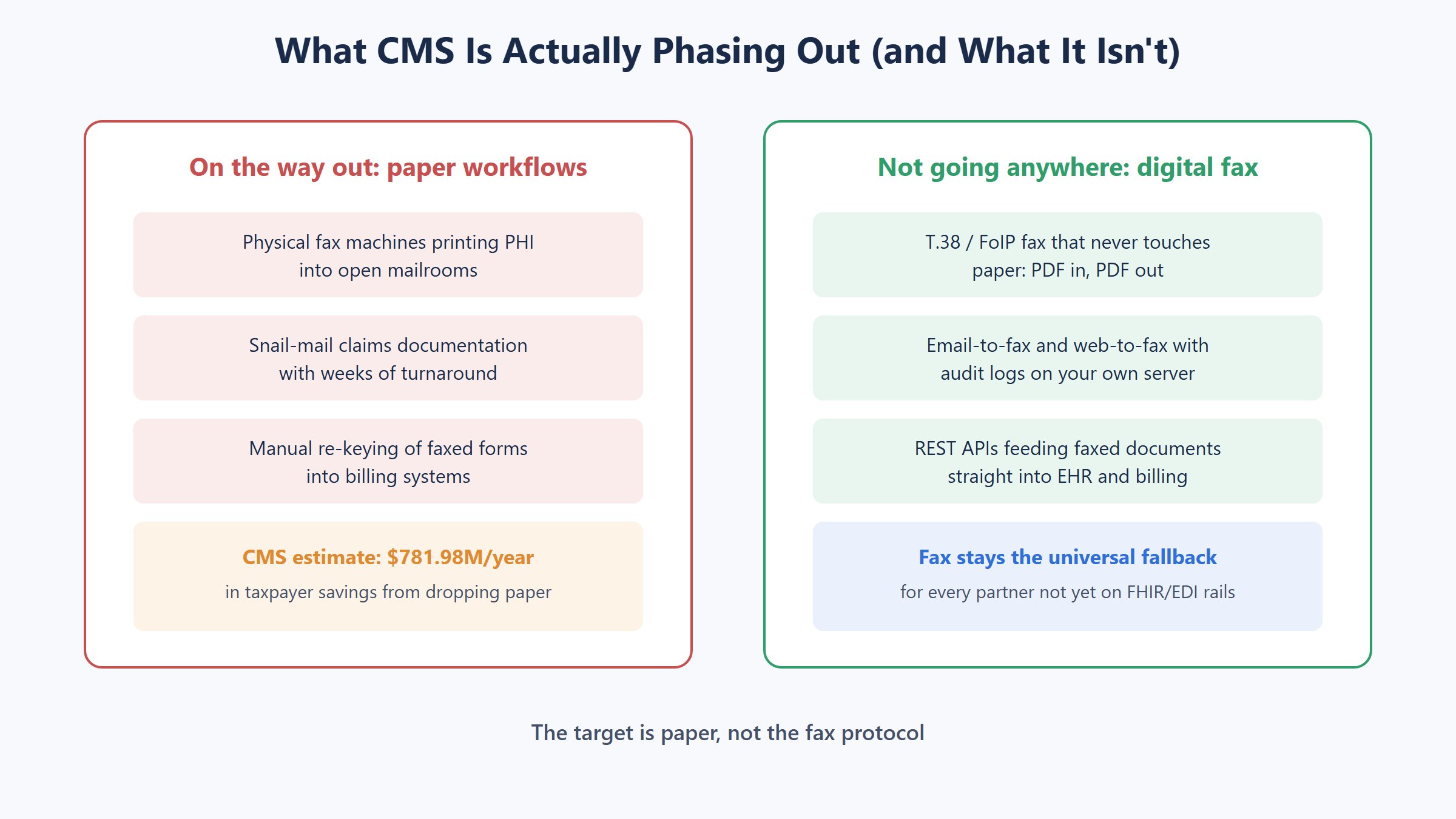
CMS put a price tag on paper this month: $781.98 million per year. That’s what the agency projects taxpayers save as its new rule phases fax machines and postal mail out of Medicare administrative workflows. Plenty of headlines compressed that into “CMS kills the fax,” which makes good copy and bad analysis.
Read the rule and a different picture shows up. The target is paper: physical machines printing protected health information into open mailrooms, envelopes crossing the country for two weeks, staff re-keying faxed forms into billing systems. Digital fax, the kind an open source fax server handles as PDFs over T.38, is a different animal entirely, and it isn’t going anywhere.
Why an Open Source Fax Server Survives the Paper Purge
The healthcare system still runs an enormous volume of document exchange over fax, and the reason is stubborn: fax is the one channel every provider, payer, pharmacy, and lab can receive. FHIR APIs and EDI rails are growing, but until the last regional clinic and the last small imaging center are on them, fax remains the universal fallback. CMS knows this, which is why the rule pushes electronic alternatives rather than banning the channel.
A digital fax server sits comfortably on the compliant side of that push. Documents arrive as PDFs, never touch paper, land in a queue with sender, timestamp, page count, and delivery result logged. Outbound faxes go from email, a web portal, or a REST API straight into the recipient’s machine or server. No mailroom, no toner, no PHI sitting in an output tray. The workflow CMS wants to eliminate simply doesn’t exist in this setup.
The Migration Path That Actually Works
Most organizations can’t flip to fully digital overnight, and honestly, they shouldn’t try. The pattern that works runs in three stages.
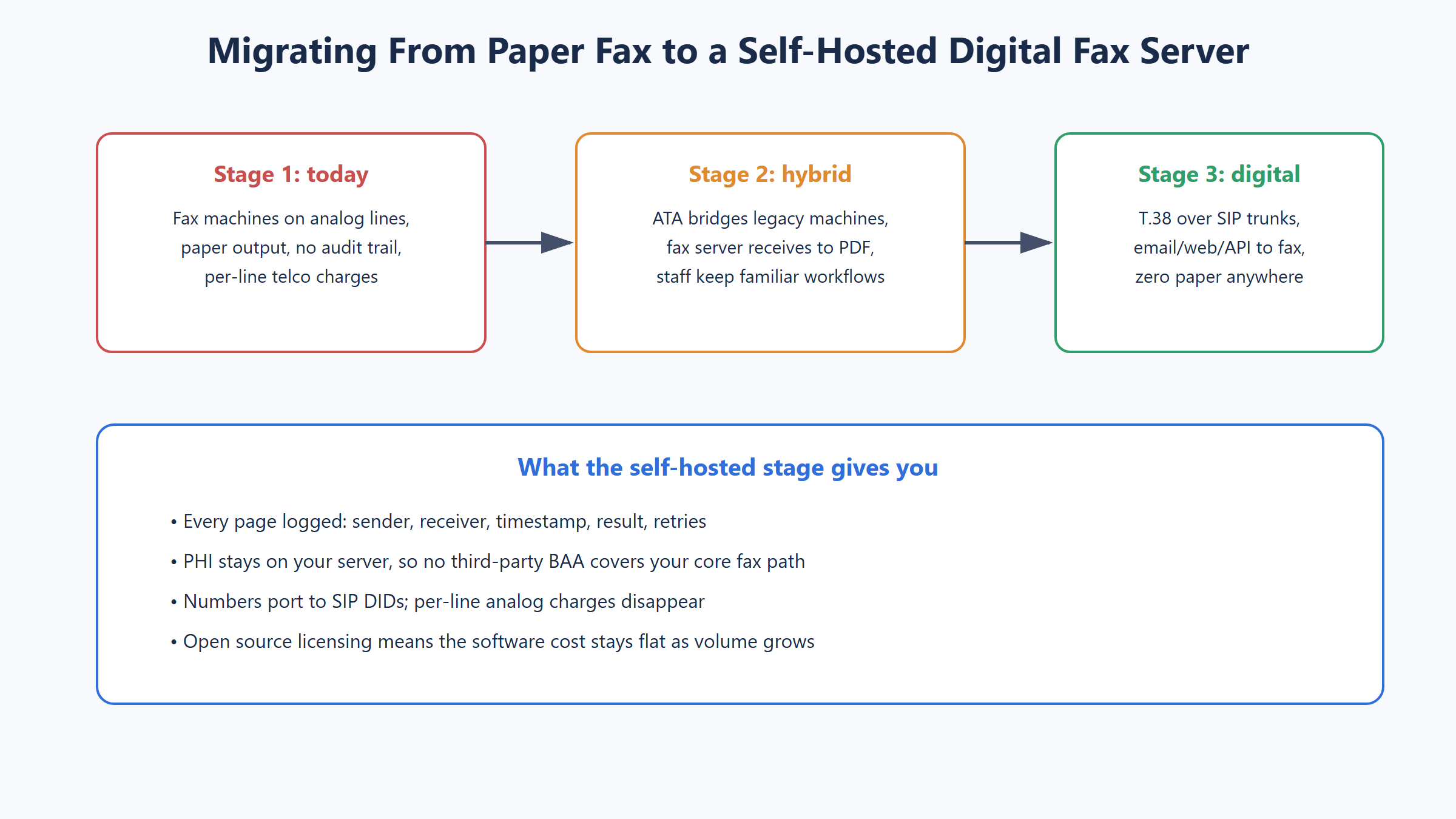
Stage one is where most clinics sit today: fax machines on analog lines, paper everywhere. Stage two bridges the gap. An ATA (analog telephone adapter) lets the old machines keep working while a fax server starts receiving inbound faxes as PDFs. Staff who love the physical machine keep it; everyone else gets email delivery. Numbers stay the same, workflows change gradually.
Stage three drops the analog lines entirely. Faxing runs over SIP trunks with T.38, the protocol built specifically to carry fax reliably across IP networks. Per-line telco charges disappear, every page is logged, and the fax server integrates with the EHR through its API. At that point your “fax” is really a structured document pipeline that happens to speak a protocol every healthcare organization on earth can receive.
Self-hosting matters more here than most write-ups admit. Cloud fax services work, but they put a third party and its BAA between you and your PHI. Run the server yourself and the documents never leave your infrastructure. For a small IT team, that’s one less vendor risk assessment, one less breach-notification dependency, and no per-page fees scaling against you.
What to Do Before the Deadlines Arrive
The CMS rule pairs with the claims-attachment standards finalized earlier this year, and both point the same direction: electronic first, paper gone, everything auditable. If your fax estate is still analog, start the hybrid stage now while there’s no deadline pressure. Port the numbers to SIP DIDs, stand up a fax server, and let the paper fade out one department at a time. Waiting until compliance letters arrive means doing the same migration on someone else’s schedule.
FAQ
Is CMS banning fax machines?
No. The rule phases paper-based fax and mail out of Medicare administrative workflows to cut costs, projected at $781.98 million per year. Electronic document exchange, including digital fax over T.38, remains fully acceptable.
What’s the difference between paper fax and digital fax?
Paper fax prints documents on physical machines over analog lines. Digital fax sends and receives the same transmissions as PDF files through a fax server over IP, with full logging and no paper output. The protocol is compatible; the workflow is completely different.
Is a self-hosted fax server HIPAA compliant?
It can be, and self-hosting simplifies the picture: PHI stays on your own server, so no third-party cloud fax vendor needs a BAA for the core fax path. You still need encryption in transit, access controls, and audit logging, which a properly configured server provides.
What is T.38 and why does it matter?
T.38 is the protocol for carrying fax over IP networks. Plain audio codecs mangle fax tones, causing failed pages. T.38 relays the fax data digitally, making fax over SIP trunks reliable enough to replace analog lines.
Can I keep my existing fax numbers when moving to a fax server?
Yes. Fax numbers port to SIP DIDs the same way voice numbers do. Inbound faxes then arrive at your server instead of an analog line, and senders notice nothing.